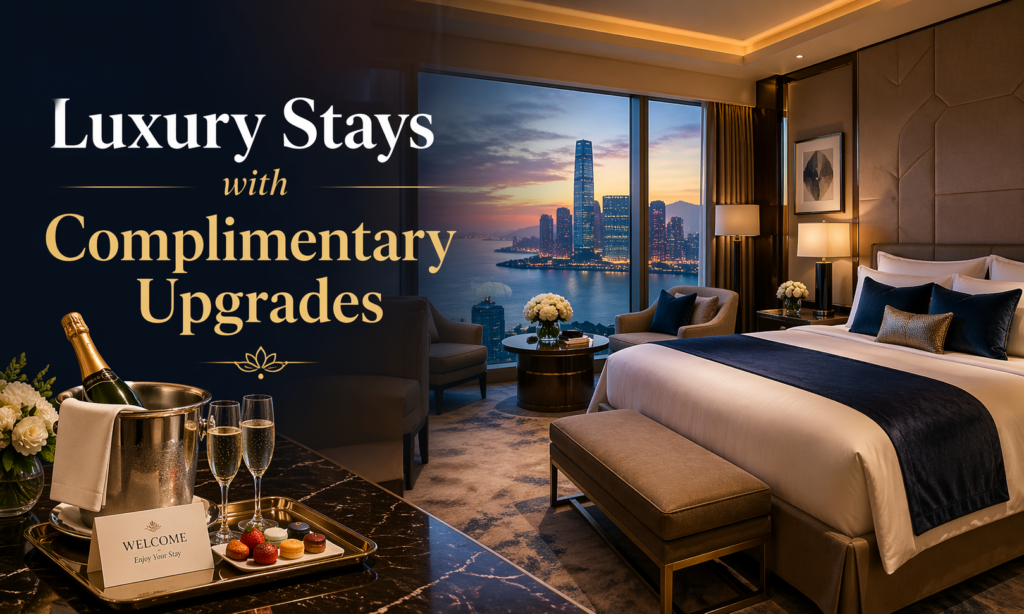
Why Complimentary Upgrades Matter More in Luxury Travel
A luxury stay with complimentary upgrades is not just about getting a bigger room. It is about feeling recognized, valued, and quietly prioritized in a market where premium travelers are no longer impressed by thread counts alone. Today’s luxury hotel experience is shaped by personalization, exclusivity, and the sense that the property understands exactly why you chose it. That shift is visible across the travel industry. McKinsey reports that the luxury segment has been growing faster than other chain-scale hotel classes, and it also notes that 68% of luxury travelers say loyalty programs are an important factor when choosing accommodations.
That matters because complimentary room upgrades sit right at the intersection of emotion and economics: they cost the guest nothing extra, but they dramatically raise perceived value. In practical terms, an upgrade can mean better views, extra space, lounge access, a quieter floor, or a suite that turns a good trip into a memorable one. In emotional terms, it feels like the hotel noticed you instead of processing you. That is why complimentary hotel upgrades have become one of the most searched and desired perks in premium travel, especially among guests who want luxury without wasting money on categories they might get upgraded into anyway.
The emotional side of this is easy to underestimate until you experience it. Booking a standard luxury room and walking into a panoramic suite feels a bit like ordering a good coffee and being handed a full tasting menu. The transaction changes shape. The guest stops thinking only about price and starts thinking about generosity, smart choice, and future loyalty.
The New Shape of Luxury Hospitality
The definition of luxury hospitality has changed, and that change is directly connected to why complimentary upgrades at luxury hotels matter so much now. A decade ago, many hotels marketed luxury through visible extravagance. Today, the premium market is moving toward quiet luxury, personalized experiences, and thoughtful convenience. Skift’s recent reporting on luxury hotels highlights a strong shift toward privacy, restraint, localization, and experience-led travel, while Accor’s 2026 trend outlook points to travelers seeking more meaningful experiential rewards, including perks such as room upgrades and occasional complimentary flights.
Hilton’s 2026 trends coverage also shows travelers prioritizing comfort, control, and connection. Put all of that together and you can see the pattern clearly: modern luxury is becoming less about excess and more about relevance. Guests want the room that fits the reason for the trip. They want calm, not clutter. They want flexibility, not friction. An upgrade works beautifully in that environment because it feels custom-made, even when it is driven by inventory management. The guest sees a better room, but what they really register is better treatment. That subtle distinction is one of the strongest forces shaping today’s luxury hotel booking strategy.
This also explains why personalization now outranks many old-school luxury signals. A hotel can have perfect decor and still feel forgettable if the experience is rigid. On the other hand, a hotel that notices you are celebrating an anniversary, places you on a quieter floor, upgrades your room category, and adds thoughtful touches will feel distinctly premium even if the original booking was modest by luxury standards. McKinsey’s luxury travel insights point to a segment that travels frequently and disproportionately values adventure and experiential elements.
How Complimentary Hotel Upgrades Actually Work
Let’s clear up a common misunderstanding. Not every complimentary room upgrade works the same way. In luxury hospitality, there are usually two major categories: standard complimentary upgrades, which are granted by the hotel based on availability and status, and confirmable upgrades, which are attached to higher-tier loyalty benefits or earned awards. That distinction matters because it changes the level of certainty.
Marriott states that Nightly Upgrade Awards can provide an advance confirmable upgrade to select premium rooms or suites, subject to availability. Hyatt similarly offers Suite Upgrade Awards that can be confirmed at the time of booking for qualifying stays, with some awards covering up to seven nights. IHG also distinguishes between complimentary upgrades for top elites, which are subject to availability and may simply move a guest to the next-best room, and Confirmable Suite Upgrades offered through Milestone Rewards.
Hilton, meanwhile, has continued evolving elite recognition, and its 2025 announcement of the new Diamond Reserve tier includes Confirmable Upgrade Rewards as part of the premium-tier package. So when travelers search for hotels with complimentary upgrades, they should understand that some upgrades are hopeful, some are status-driven, and some can actually be locked in before arrival.
Availability is the second piece of the puzzle, and it is where strategy starts to matter. Hotels do not upgrade guests in a vacuum. They do it based on occupancy, room mix, stay dates, operational priorities, guest profile, and brand policy. A one-night midweek stay may be easier to upgrade than a five-night holiday booking in a sold-out destination. A guest booking directly with the hotel and holding elite status may present less friction than a last-minute third-party reservation with no profile history.
Hotel Loyalty Programs That Improve Your Upgrade Chances
If you want luxury stays with complimentary upgrades to become a repeatable travel pattern rather than a happy surprise, loyalty programs matter. Marriott Bonvoy remains one of the biggest names in the premium hotel space, and its structure gives elite members access to Nightly Upgrade Awards as an Annual Choice Benefit at certain status levels.
For travelers who prefer a wide property footprint, that flexibility is appealing. Hyatt takes a more focused but often highly praised route with Suite Upgrade Awards and milestone-based rewards. Hyatt’s official member benefits pages explain that these awards can confirm a standard suite at booking for stays of up to seven nights, which is extremely attractive for travelers who want certainty before arrival. In simple terms, Marriott offers breadth, Hyatt offers clarity, and both create stronger pathways to luxury hotel room upgrades than casual one-off bookings usually provide.
Hilton and IHG add their own compelling angles to the conversation. That has highlighted “best-in-industry room upgrades” in its premium-tier messaging and announced that its Diamond Reserve tier includes Confirmable Upgrade Rewards, guaranteed 4 p.m. late checkout, and dedicated support. Hilton has also pointed to technology improvements such as automated complimentary room upgrades and Digital Key tools that reduce front-desk friction.
Best Times to Book Luxury Stays for Better Upgrade Odds
Timing changes everything when you are chasing complimentary suite upgrades. Hotels are more generous when inventory gives them room to be generous. That usually means shoulder seasons, midweek arrivals in business-heavy cities, and shorter stays where moving you into a better room does not create too much downstream operational pain. If a property expects peak occupancy with many premium categories already sold, the upgrade pool shrinks fast. This is where the modern luxury landscape helps informed travelers.
Skift’s outlook on hotels and luxury hospitality suggests that brands are working in a market still defined by strong competition, evolving loyalty models, and guest expectations around differentiated value. In a competitive premium environment, a complimentary upgrade becomes one of the easiest high-impact gestures a hotel can make. The irony is beautiful: sometimes the smartest luxury move is not spending more, but booking more intelligently.
Direct booking also deserves real attention here. Hotels increasingly want guests to book through their own channels because direct bookings reduce distribution costs and deepen guest data. That matters for upgrades because the hotel can see more of your profile, attach your loyalty history cleanly, and justify the extra gesture more easily. Hilton, Hyatt, IHG, and Marriott all heavily emphasize member-facing direct-booking ecosystems, app functionality, or program-linked reservations.
Smart Booking Tactics for Complimentary Upgrades
The best tactics for getting a complimentary luxury hotel upgrade are surprisingly simple, but they work best when combined. First, join the hotel’s loyalty program even if you are only taking one trip. Membership is free in major programs and instantly gives the property a clearer framework for recognizing you. Second, book the room category you would genuinely be happy to stay in. Hotels are much more willing to delight a satisfied guest than rescue a disappointed one. Third, check in at a time when the front desk has room to maneuver.
Fourth, ask with warmth and precision. A line like, “If any complimentary upgrades are available, I’d be grateful to be considered,” lands far better than “Can I get a suite?” Fifth, make your profile easy to like: complete guest details, travel history, celebration notes when real, and a courteous tone in pre-arrival communication. None of this guarantees anything, but taken together, these details create the kind of guest profile hotels naturally want to reward.
There is also a human side to front-desk decision-making that travelers often ignore. The hotel team is balancing fairness, policy, inventory, VIP arrivals, and operational stress in real time. That means attitude matters. A traveler who is respectful, flexible, and clearly informed often stands out more than one who throws around elite jargon. It also helps to understand what an upgrade can realistically mean at a specific property. At one hotel, the next category may be a garden-view room with more space.
What Types of Luxury Travelers Benefit Most
Couples on special occasions, honeymooners, anniversary travelers, and guests celebrating milestone birthdays often benefit because hotels understand the storytelling value of elevating those stays. A suite upgrade for a honeymoon is not just a room move. It is a memory multiplier. Business travelers also have a strong case, especially those who stay repeatedly with the same brand and book direct.
McKinsey’s work on luxury travelers and hotel experience shows that recognition and attentive service matter deeply in premium travel, and repeat business gives hotels a clear reason to deliver both. Guests who travel often for work sometimes overlook the luxury angle, but they are actually ideal candidates for better rooms because they combine frequency, revenue, and future booking potential. When a hotel upgrades that kind of guest, it is not just rewarding one stay. It is investing in a relationship.
They know which brands fit their habits, which properties tend to recognize status well, and how to position each booking for the best outcome. That knowledge compounds over time. One traveler treats every stay as a standalone transaction.
Conclusion
Luxury stays with complimentary upgrades sit in a sweet spot that modern travelers love: they combine aspiration, value, and emotional payoff in one elegant package. The current luxury travel market is growing, competition among premium hotel brands remains intense, and major loyalty programs are making upgrade pathways more structured than they used to be. That creates real opportunity for travelers who know how to book wisely. The best approach is not magical and it is not manipulative.